Introduction
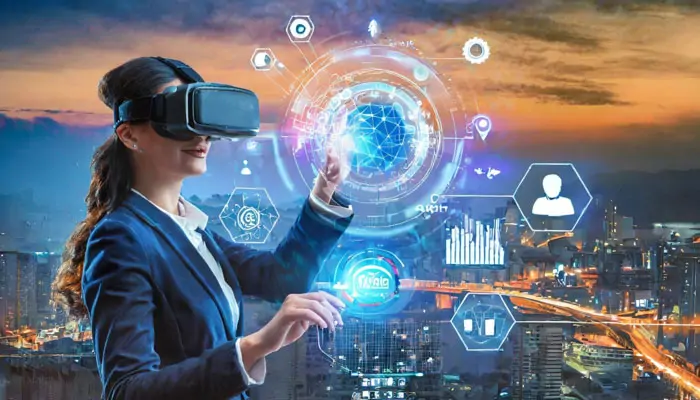
Virtual Reality, commonly known as VR, has evolved from a futuristic concept into a rapidly developing technology that is changing the way people interact with digital environments. What once appeared mainly in science-fiction movies and experimental laboratories is now available through consumer headsets, gaming systems, educational platforms, training applications, and professional tools.
The future of virtual reality technology is expected to be even more transformative. Advances in artificial intelligence, computer vision, spatial computing, display technology, sensors, wireless connectivity, and cloud computing are helping make virtual experiences more realistic, interactive, and accessible.
Virtual reality can create computer-generated environments that allow users to look around, move, interact with objects, and experience digital spaces in an immersive way. As hardware becomes lighter and software becomes smarter, VR may become increasingly useful beyond entertainment.
Industries such as healthcare, education, manufacturing, tourism, architecture, retail, engineering, business, and entertainment are already exploring virtual reality. In the coming years, VR could become an important part of everyday digital experiences.
This article explores the future of virtual reality technology, including emerging trends, applications, benefits, challenges, artificial intelligence integration, business opportunities, and the potential impact of VR on everyday life.
What Is Virtual Reality Technology?
Virtual Reality is a technology that creates an immersive digital environment using specialized hardware and software. A typical VR system may include a headset with displays, cameras, motion sensors, speakers, and controllers.
Instead of simply viewing information on a traditional screen, users can feel as if they are inside a digital environment. The system tracks head and body movements and changes the virtual scene accordingly.
For example, when a user turns their head while wearing a VR headset, the virtual environment can respond in real time. This creates a stronger sense of presence than traditional computer or mobile interfaces.
Modern VR systems can support:
- 3D environments
- Motion tracking
- Hand tracking
- Spatial audio
- Interactive objects
- Virtual simulations
- Multiplayer experiences
- Educational environments
- Professional training
- Immersive entertainment
As technology continues to improve, these capabilities are likely to become more advanced.
Why Is the Future of Virtual Reality Important?
The future of virtual reality matters because digital interaction is becoming increasingly immersive. Traditional computing generally requires people to look at a screen and interact through keyboards, mice, or touchscreens.
VR introduces a different approach. Instead of simply observing digital information, users can enter and interact with a simulated environment.
This could change how people:
- Learn new skills
- Attend virtual events
- Work with remote teams
- Design products
- Explore destinations
- Receive certain forms of training
- Play games
- Experience entertainment
- Visualize complex information
The growing combination of VR with artificial intelligence and spatial computing could make virtual environments more intelligent and responsive.
The Evolution of Virtual Reality
Virtual reality has a long history of development. Early experiments focused on creating stereoscopic images and simulated environments. However, the technology was expensive and limited for many years.
As computing power increased, developers began creating more advanced graphics and interactive experiences.
The development of modern smartphones also contributed to the growth of VR because smartphones introduced powerful processors, compact sensors, high-resolution displays, and motion-detection technologies.
Later, dedicated VR headsets improved the experience by offering better displays, tracking, controllers, and specialized software.
Today, VR is no longer limited to research laboratories. Consumers, businesses, schools, and professional organizations can use VR systems for a growing range of applications.
The next stage of development is likely to focus on making VR more natural, comfortable, intelligent, affordable, and useful.
Lighter and More Comfortable VR Headsets
One of the biggest challenges facing VR has been headset size and comfort.
Early consumer VR headsets could be relatively heavy and uncomfortable during extended use. Future devices are expected to become lighter, thinner, and more ergonomic.
Advances in display components, batteries, processors, lenses, and materials may allow manufacturers to reduce headset size without sacrificing performance.
Future VR headsets could potentially resemble lightweight glasses rather than large traditional head-mounted devices.
Improved comfort will be important because users are more likely to adopt VR technology if they can comfortably use it for longer periods.
Higher-Resolution Displays
Display quality is another major area of development.
Modern VR systems already provide impressive visual experiences, but future displays are expected to deliver greater resolution, improved contrast, better color accuracy, and faster refresh rates.
Higher-resolution displays can reduce the visible pixel structure that some users experience in VR.
Future headsets may also use advanced display technologies that provide clearer images while consuming less energy.
Better displays could make virtual environments more convincing and useful for professional applications such as engineering, medicine, education, and design.
Eye Tracking Technology
Eye tracking is expected to become increasingly important in future VR systems.
Eye-tracking technology allows a headset to determine where the user is looking. This can be used for navigation, interaction, accessibility, and performance optimization.
One important application is a technique known as foveated rendering. Human vision is naturally sharper in the area directly being focused on. A VR system can use eye tracking to allocate more graphical processing to the area where the user is looking.
This may improve performance while reducing unnecessary processing.
Eye tracking could also allow users to select virtual objects simply by looking at them.
Hand Tracking and Natural Interaction
Traditional VR controllers provide precise interaction, but future systems may increasingly rely on natural hand tracking.
Cameras and sensors can detect hand movements and gestures. This allows users to interact with virtual objects without holding physical controllers.
For example, a user might:
- Pick up a virtual object
- Point toward an item
- Press a virtual button
- Move digital objects
- Use hand gestures to navigate menus
Improved hand tracking could make VR more intuitive for beginners.
It could also benefit professional applications where natural interaction is useful.
Artificial Intelligence and Virtual Reality
Artificial intelligence is likely to play a major role in the future of VR.
AI can help create intelligent virtual characters, generate environments, understand user behavior, and improve interactions.
Instead of experiencing a fixed virtual environment, users may eventually interact with virtual spaces that dynamically respond to their actions.
AI-powered virtual characters could understand natural language and respond to conversations more naturally.
For example, an educational VR application could provide a virtual tutor that explains concepts according to a student’s needs.
In professional training, an AI-powered virtual instructor could adapt scenarios based on a user’s performance.
The combination of AI and VR could therefore make virtual experiences more personalized and interactive.
AI-Generated Virtual Worlds
Creating detailed virtual environments traditionally requires significant amounts of time and resources.
Generative AI could help developers create virtual environments more efficiently.
A developer could describe a location, object, or scenario, and AI systems could assist with generating relevant digital assets.
This could reduce development time and make VR content creation more accessible.
In the future, users may even be able to generate personalized virtual environments through simple text or voice instructions.
Virtual Reality in Gaming
Gaming remains one of the most important applications of virtual reality.
Traditional video games place players outside the digital world while VR can place them inside it.
Players can look around naturally, interact with objects, and experience environments from a first-person perspective.
Future VR games may offer:
- More realistic environments
- Intelligent AI characters
- Better multiplayer systems
- Full-body tracking
- Advanced physics
- Improved haptic feedback
- More natural interaction
- Larger virtual worlds
The combination of AI and VR could also create game characters that behave more dynamically.
Instead of following limited scripted responses, future characters may respond differently depending on player actions.
The Future of VR Entertainment
VR could transform entertainment beyond traditional gaming.
Movies, concerts, sports events, museums, and live performances could become immersive experiences.
Imagine watching a virtual concert where you can look around the environment and feel as if you are standing near the stage.
Similarly, a sports viewer could potentially experience an event from different virtual viewpoints.
Virtual reality may not completely replace traditional entertainment, but it could create an additional format for experiencing content.
Virtual Reality in Education
Education is one of the most promising areas for VR.
Traditional education often relies on textbooks, videos, diagrams, and classroom demonstrations. VR can provide interactive three-dimensional experiences.
Students could explore historical locations, travel through the human body, examine scientific structures, or conduct simulated experiments.
For example, a history lesson could allow students to explore a reconstruction of an ancient city.
A science lesson could allow students to examine the structure of a cell in three dimensions.
Virtual reality can make abstract subjects more visual and interactive.
VR for Medical Education
Medical education requires students to understand complex anatomy and procedures.
VR can provide simulated environments where learners can study anatomy or practice certain procedures in controlled settings.
One major advantage of simulation is that learners can repeat exercises without needing to recreate a physical environment each time.
Future systems could combine VR with AI to provide feedback during training.
However, virtual simulations are intended to complement appropriate professional education and should not automatically be treated as substitutes for real-world clinical training.
Virtual Reality in Healthcare
VR is also being explored for healthcare applications.
Depending on the specific use and clinical evidence, VR may support areas such as rehabilitation, training, visualization, and certain therapeutic experiences.
For example, VR environments can provide controlled exercises for physical rehabilitation.
Healthcare professionals may also use immersive visualization tools to better understand complex structures.
As medical technology develops, VR could become a valuable component of selected healthcare workflows.
Virtual Reality in Workplace Training
Training employees in real environments can sometimes be expensive or difficult.
VR can simulate realistic environments where employees can practice procedures and decision-making.
Industries such as aviation, manufacturing, construction, emergency response, and industrial operations can benefit from simulation-based learning.
Employees can practice scenarios without necessarily being exposed to the same real-world risks during early training.
Future VR training systems may use AI to adjust difficulty according to individual performance.
VR in Architecture and Real Estate
Architecture is another field that can benefit significantly from virtual reality.
Architects can create virtual models of buildings and allow clients to explore them before construction.
Instead of looking at a flat floor plan, a client could walk through a virtual representation of the proposed building.
VR can help users understand:
- Room layouts
- Building scale
- Interior design
- Lighting concepts
- Furniture placement
- Spatial relationships
Real estate companies may also use VR to provide immersive property tours.
This could be especially useful when buyers cannot physically visit a property.
Virtual Reality in Tourism
Tourism could also be influenced by VR.
Virtual tours can allow people to explore destinations before deciding whether to visit them.
Museums, historical landmarks, national parks, and cultural locations could create immersive digital experiences.
Virtual tourism will not necessarily replace physical travel. Instead, it can provide an alternative way to explore places, especially for people who cannot travel easily.
Travel companies may also use VR to provide previews of hotels, attractions, and destinations.
VR and Remote Work
Remote work has increased the demand for better digital collaboration tools.
Video calls provide communication, but participants generally remain represented by flat images on screens.
VR could create virtual meeting rooms where users appear as avatars in shared environments.
Participants could potentially:
- View presentations
- Work with 3D models
- Write on virtual boards
- Discuss documents
- Manipulate virtual objects
- Communicate with remote colleagues
Future virtual workplaces may become more sophisticated as hardware and software improve.
The Growth of Social Virtual Reality
Social interaction is another important area for VR.
Virtual reality platforms can allow people to meet in shared digital spaces using avatars.
Users can communicate through voice, gestures, facial expressions, and body movements.
Future systems may improve avatar realism and social interaction.
However, privacy, safety, moderation, and responsible platform design will remain important as social VR develops.
Spatial Computing and Virtual Reality
Spatial computing refers to technologies that allow digital content to interact with physical space.
VR is closely connected to this broader trend.
Future devices may seamlessly combine virtual and physical environments, creating experiences that move beyond the traditional idea of a completely isolated virtual world.
Spatial computing can include:
- 3D interfaces
- Environment mapping
- Gesture recognition
- Spatial audio
- Computer vision
- Augmented reality
- Virtual reality
- Mixed reality
This convergence could create a more flexible future for immersive computing.
Virtual Reality and Mixed Reality
Virtual reality completely replaces the user’s visual environment with a digital one.
Mixed reality, by contrast, can combine digital objects with the physical environment.
Future devices may make switching between these experiences easier.
A user might work with digital 3D objects, enter a fully virtual training environment, and then return to a mixed-reality workspace using the same general computing platform.
This convergence could make immersive technology more practical for everyday use.
Better Haptic Feedback
Visual and audio feedback are important, but touch can make virtual experiences more convincing.
Haptic technology creates physical sensations through vibration, pressure, resistance, or other forms of feedback.
Future VR systems may use more advanced haptic controllers, gloves, wearable devices, or other interfaces.
For example, a virtual object could produce a sensation when touched.
Haptic feedback could improve applications in gaming, training, simulation, and education.
Full-Body Tracking
Current VR systems can track the head and hands, but future technology may track more of the user’s body.
Full-body tracking could make avatars move more naturally.
This could improve:
- Gaming
- Fitness applications
- Sports training
- Social VR
- Professional simulations
- Virtual performances
More accurate tracking may also improve immersion and communication between users.
Wireless Virtual Reality
Wireless connectivity is another important development area.
Wireless VR reduces the need for cables between headsets and computers, allowing users to move more freely.
Advances in wireless networking and device processors could make high-quality wireless VR more practical.
Future systems may provide lower latency and more reliable connections.
This will be particularly important for multiplayer experiences and cloud-based applications.
Cloud Computing and Virtual Reality
Cloud computing could help reduce the processing requirements of VR devices.
Instead of performing every computational task locally, some processing can potentially happen on remote servers.
This could allow smaller devices to access more advanced experiences.
However, cloud-based VR depends heavily on reliable networks and low latency.
As connectivity improves, cloud technologies may become increasingly important for immersive applications.
The Future of VR Hardware
VR hardware is likely to become:
- Smaller
- Lighter
- Faster
- More powerful
- More energy efficient
- More comfortable
- More wireless
- More intelligent
Sensors will become more accurate, displays will improve, and processors will become more capable.
The goal is to create devices that feel less like specialized technology and more like natural computing tools.
The Future of VR Software
Hardware alone cannot make VR successful.
High-quality software and content are equally important.
Future VR software is expected to provide better graphics, physics, interaction, artificial intelligence, multiplayer features, and accessibility.
Developers will also need to create applications that solve real problems rather than simply demonstrating technological capabilities.
The strongest VR applications are likely to be those that provide clear value to users.
Accessibility in Virtual Reality
Accessibility should be an important part of future VR development.
Not everyone can interact with technology in the same way.
Developers may need to provide customizable controls, voice interaction, subtitles, visual adjustments, seated modes, and other accessibility features.
Improving accessibility can make VR useful to a broader range of people.
Challenges Facing Virtual Reality
Despite its potential, VR faces several challenges.
Cost
High-quality VR hardware and computers can be expensive.
Lower prices could be important for mass adoption.
Comfort
Long sessions can be uncomfortable for some users. Weight, heat, battery life, and fit remain important considerations.
Motion Discomfort
Some people experience discomfort when visual movement does not perfectly match physical movement.
Improved tracking, display technology, and software design may help reduce this issue, although experiences vary between individuals.
Content
A large and diverse library of high-quality applications is necessary for continued growth.
Privacy
VR devices can collect information about movement, surroundings, interactions, and potentially other forms of user data.
Privacy protections will therefore become increasingly important.
Privacy and Security in VR
Future VR systems may collect more data than traditional devices.
Potentially sensitive information could include:
- Movement patterns
- Voice data
- Environmental information
- Interaction behavior
- Device information
- Account information
Companies developing VR platforms will need strong privacy and security practices.
Users should also understand what information applications collect and how it is used.
The Environmental Impact of VR
Technology development also creates environmental considerations.
Manufacturing headsets requires materials, energy, and electronic components.
As VR adoption grows, manufacturers may face greater pressure to improve energy efficiency, product durability, repairability, and recycling.
Future VR devices could become more energy efficient and potentially use more sustainable materials.
The Business Future of Virtual Reality
Virtual reality could create new business opportunities.
Potential areas include:
- VR software development
- Virtual training
- Immersive advertising
- Virtual events
- Digital tourism
- Architecture visualization
- Healthcare applications
- Educational platforms
- Enterprise collaboration
- Gaming
- Virtual retail
Businesses that identify practical problems VR can solve may benefit from the growth of immersive technology.
Virtual Reality in Retail
Retailers can use VR to provide immersive shopping experiences.
Customers could potentially explore virtual stores, examine products in three dimensions, or visualize how furniture could look in a room.
VR could also support product demonstrations.
However, the success of virtual retail will depend on convenience and usefulness rather than novelty alone.
VR and Digital Marketing
Marketing may also change as immersive technologies develop.
Traditional advertisements are usually viewed on screens. VR could provide interactive product experiences.
A company might allow customers to explore a virtual showroom or experience a product demonstration.
Immersive marketing could become an additional channel for businesses seeking to engage customers.
Virtual Events and Conferences
Virtual reality could make online events more interactive.
Instead of watching a video conference, participants could enter a virtual venue and interact with other attendees.
Virtual conferences could include:
- Exhibition halls
- Presentation rooms
- Networking spaces
- Interactive demonstrations
- Virtual product displays
This could create new options for global events.
The Future of Virtual Reality and AI Avatars
AI-powered avatars could become more sophisticated.
Instead of simple animated characters, future avatars may respond naturally to voice commands, facial expressions, gestures, and context.
AI could help generate realistic conversations and behaviors.
This could be useful for education, customer service, training, entertainment, and social experiences.
Virtual Reality and the Metaverse
The concept of the metaverse became widely discussed as companies explored persistent digital environments.
VR is one possible interface for these environments.
However, the future of immersive digital platforms is still developing. Successful platforms will likely need practical uses, strong communities, useful applications, good hardware, and responsible policies.
VR may become an important component of broader digital ecosystems rather than a single universal platform.
VR and the Future of Human-Computer Interaction
The long-term impact of VR may extend beyond entertainment.
Traditional computing uses keyboards, mice, touchscreens, and voice interfaces.
Future computing could combine:
- Eye movement
- Hand gestures
- Voice
- Body movement
- Spatial awareness
- AI assistance
This could make interaction with computers more natural.
Instead of learning complicated interfaces, users may increasingly communicate with digital systems in ways similar to interacting with physical environments.
What Will VR Look Like in the Future?
The future VR experience may be significantly different from today’s headsets.
A future system could potentially be lightweight, wireless, AI-powered, highly responsive, and capable of switching between virtual, augmented, and mixed-reality experiences.
Users may interact with digital environments using their eyes, hands, voice, and body.
Virtual environments could become more realistic while AI could make them more dynamic.
Is Virtual Reality the Future of Technology?
Virtual reality is unlikely to replace every existing technology.
Instead, it is more likely to become one component of a broader technological ecosystem.
Smartphones, computers, tablets, wearables, augmented reality devices, VR systems, and AI assistants may all coexist.
The importance of VR will depend on whether it can provide meaningful advantages over traditional interfaces.
For certain tasks, a normal screen will remain more convenient. For others, immersive 3D environments may provide significant benefits.
Benefits of Future Virtual Reality Technology
Future VR systems could provide several benefits:
Immersive Learning
Students can explore interactive environments rather than relying only on traditional materials.
Safer Training
Workers can practice certain scenarios in simulations before dealing with real-world situations.
Remote Collaboration
Teams can meet in shared digital spaces.
Better Visualization
Complex objects and environments can be represented in three dimensions.
New Entertainment Experiences
Games, concerts, events, and other entertainment formats can become immersive.
Greater Accessibility to Experiences
People may virtually explore locations or experiences that are difficult to access physically.
Potential Disadvantages of Future VR
VR also has limitations.
Potential concerns include:
- Hardware cost
- Privacy risks
- Excessive screen or headset use
- Motion discomfort
- Social concerns
- Data security
- Technical limitations
- Digital addiction concerns
- Environmental costs
Responsible development will be necessary to ensure that VR provides genuine value without creating unnecessary risks.
How Businesses Can Prepare for the Future of VR
Businesses interested in VR should first identify practical use cases.
Rather than adopting VR simply because it is popular, companies can consider questions such as:
- What problem can VR solve?
- Would immersive technology improve the user experience?
- What hardware is required?
- What content needs to be created?
- How will users be trained?
- What privacy requirements apply?
- How will success be measured?
A practical strategy can help businesses avoid investing in technology without a clear purpose.
The Role of Developers
Developers will play a major role in shaping the future of virtual reality.
They will create the applications, games, simulations, educational environments, social platforms, and professional tools that users experience.
Future developers may need knowledge of:
- 3D graphics
- Game engines
- Artificial intelligence
- Computer vision
- User experience design
- Spatial computing
- Cloud computing
- Networking
- Human-computer interaction
As VR grows, demand for specialized skills may increase.
The Importance of User Experience
A technically impressive VR application can still fail if it is difficult to use.
Future developers will need to focus on simplicity, comfort, accessibility, and intuitive interaction.
The best VR experiences will likely hide technical complexity from users.
People should be able to enter an environment and understand how to interact without needing extensive instructions.
The Future of VR in the Next Decade
Over the next decade, several trends may shape the development of virtual reality.
Headsets are likely to become more comfortable and capable. Artificial intelligence may become deeply integrated into virtual environments. Eye tracking and hand tracking may become more common.
Cloud computing and high-speed wireless networks could support more advanced experiences.
VR may also become more common in professional training, education, entertainment, design, and collaboration.
However, adoption will depend on cost, comfort, useful content, privacy, and consumer demand.
Long-Term Vision for Virtual Reality
Looking further ahead, VR could become part of a broader ecosystem of spatial computing.
Instead of thinking of VR as simply wearing a headset, people may interact with digital information in three-dimensional spaces.
AI could create responsive environments. Sensors could understand the user’s surroundings. Advanced displays could make digital objects appear increasingly realistic.
The boundary between physical and digital interaction may become less obvious.
This does not necessarily mean that people will spend all their time in virtual worlds. Instead, immersive technology may become another tool used when it provides a meaningful advantage.
Frequently Asked Questions About the Future of Virtual Reality
What is the future of virtual reality technology?
The future of virtual reality is expected to involve lighter hardware, better displays, improved tracking, artificial intelligence, wireless connectivity, advanced haptics, and more practical applications across industries.
Will VR become more affordable?
As technology matures and production scales increase, VR hardware may become more affordable. However, pricing will depend on hardware capabilities, manufacturing costs, and market demand.
How will AI affect virtual reality?
AI can make virtual environments more interactive and personalized. It can support intelligent virtual characters, content creation, adaptive training, and natural-language interaction.
Will VR replace smartphones?
It is unlikely that VR will completely replace smartphones in the near future. Different devices serve different purposes, and smartphones remain convenient for many everyday tasks.
Can VR be used for education?
Yes. VR can provide immersive simulations, 3D visualization, virtual field trips, scientific experiences, and training environments.
What industries will benefit most from VR?
Gaming, education, healthcare, architecture, engineering, training, tourism, entertainment, retail, and remote collaboration are among the areas with significant potential.
What are the biggest challenges for VR?
Cost, comfort, motion discomfort, privacy, content availability, battery life, accessibility, and hardware limitations remain important challenges.
Will VR become part of everyday life?
VR may become more common as hardware becomes smaller, more comfortable, affordable, and useful. However, adoption will depend on whether consumers find enough practical value in immersive experiences.
Conclusion
The future of virtual reality technology is full of possibilities. VR has already moved beyond science fiction and entered gaming, education, training, design, entertainment, and other areas.
The next generation of VR is likely to be shaped by artificial intelligence, advanced displays, eye tracking, hand tracking, spatial computing, wireless connectivity, cloud technology, and improved haptic feedback.
The most important development may not simply be better graphics. Instead, the future of VR will depend on creating experiences that are genuinely useful, comfortable, accessible, and easy to use.
As virtual reality continues to evolve, it could change the way people learn, work, communicate, create, and experience digital content.
VR will not necessarily replace traditional computers, smartphones, or other technologies. Instead, it may become an important part of a larger ecosystem of immersive and intelligent computing.
For businesses, educators, developers, and consumers, understanding the future of virtual reality technology can help them prepare for a world in which digital experiences become increasingly interactive and three-dimensional.
The future of VR is still being written, but one thing is clear: virtual reality has the potential to become one of the most important technologies shaping the next generation of digital experiences.